Showing posts with label Mountain View. Show all posts

Thursday, October 19, 2017

Theatreworks: The Prince of Egypt

Left to right: Jason Gotay, Diluckshan Jeyaratnam. Photo courtesy Kevin Berne and TheatreWorks.
Dreamworks’ 1998 movie The Prince of Egypt, an adaptation of the story of Exodus, thrilled audiences with its superb animation and Stephen Schwartz-composed music. The film’s lynchpin song, “When You Believe,” won Schwartz an Academy Award for Best Original Song. Theatreworks’ world premiere adaptation, directed by Scott Schwartz and featuring a selection of new music, translates the majesty of the original work in a way that can only be expressed on the stage.

Central to the work are Moses (Diluckshan Jeyaratnam) and his brother Ramses (Jason Gotay), crown prince of Egypt. Jeyaratnam’s Moses is mischievous, emotional, and tormented by the actions he has to take as God’s chosen one. This human interpretation of Moses is an interesting departure from the Moses-as-inscrutable-prophet version in the public perception. Meanwhile, Gotay portrays Ramses not as a force of evil, but a pitiful figure crushed by the expectations held of him. Though he is responsible for the continual enslavement of the Hebrews, it stems more from weakness than malice. Ramses’ confrontation with Moses is as inevitable as it was in Exodus, but in this production, Gotay gives us a sense of tragedy on both sides.

The rest of the cast delivers equally stellar performances. Brennyn Lark’s Tzipporah ventures into romance with Moses without losing the fiery independence at the core of her character. Tom Nelis approaches the role of old pharaoh Seti like one would approach Shakespeare’s Caesar, weighing down the younger characters with his gravitas even after his death. High priest Hotep (Will Mann) is elevated from a goofy minor antagonist in the film to a force of authority responsible for many of Ramses’ worst decisions; Mann’s balance of sinister power and cartoony outrage is perfect for the role.

The songs in the musical are a combination of the award-winning soundtrack from the movie and new work made specifically for the stage adaptation. The opening song “Deliver Us” retains its overwhelming grandeur, setting the stage for the great scope of the story as a whole. Moses’ new song “Footprints on the Sand” prefaces his journey through his desire to accomplish something meaningful, not just to live in luxury. “One of Us”, another new number at the beginning of the second act, uses a jaunty tune and fun rhymes to lighten the mood before the Exodus truly begins.

Because the movie made frequent use of expensive artistic elements, one would expect the stage adaptation to do the same. Instead, the technical elements are restrained, making use of minimal props and sets to tell its story. Much of the musical’s visual aesthetic is created through the work of choreographer Sean Cheeseman; a talented ensemble uses dance to construct such set pieces as the wall of an Egyptian palace or the fire through which God speaks to Moses. What can’t be represented through human motion is created through Shawn Sagady’s projection work or set designer Kevin Depinet’s multipurpose stone blocks. This technical work avoids the long shadow created by the musical’s predecessor, creating a visual spectacle that can only be achieved by live theatre.


The Prince of Egypt at Theatreworks is more of a reinterpretation of both the original film and the story of Exodus than a retelling. Not only are the structure and characterization different, but even major story components like Ramses drowning in the Red Sea are changed. Even if you’ve seen the film, the stage adaptation creates a fresh perspective through a talented cast delivering new takes on familiar characters and a visual style that makes use of the theatre’s ability to represent through movement.

Saturday, January 3, 2015

New Mongolian BBQ


Location: Mountain View, CA

Food: Mongolian Barbecue

Close to: Mountain View Center for the Performing Arts (TheatreWorks), Pear Avenue Theatre

Mountain View’s Castro Street has a constantly changing wealth of dining options, ranging from Chinese bakeries to family-style pizzerias. For the enterprising theatregoer, one of the street’s best options is New Mongolian BBQ, which combines delicious food, a low wait time, and a reasonable price. Evidence of its quality can be seen in its longevity: It has been operating since 1973 on Mountain View’s Castro Street, one of the Peninsula’s most volatile shopping districts.

New Mongolian BBQ uses an all-you-can-eat system ($12 for a meal, weekday lunches $10) where you choose a variety of meat, noodles, vegetables, and sauces and give them to the chef, who will cook them to perfection on a gigantic open grill. You can go back as many times as you like or partake in unlimited vegetable egg rolls and soft serve ice cream. Because the ingredients are high quality, the fact that you can get your food quickly doesn’t influence how good it tastes.

The restaurant’s selection is wide enough to appeal to those with specific tastes, but provides guidance for the indecisive. This policy can be seen most clearly in the variety of ten sauces: There is a written guide with several standard combinations for the new restaurant goer, but nothing stops you from putting three ladles of sweet-and-sour and two ladles of chili sauce on your noodles. Garlic lovers like me will be pleased by the garlic powder you can add on your dish after it cooks.

This freedom of choice gives vegetarians and vegans a surprising number of options for what is ostensibly a barbecue. There are a number of seasonal fruits and vegetables, including unusual options like pineapple and water chestnuts alongside tofu, onions, and mushrooms. My personal favorite is the little baby corn, which adds a sweet crunch to meat dishes and acts as the star of the show in vegetable ones. Though the meat is excellent, there are many ways to create a non-meat dish that is just as satisfying.

In some ways, New Mongolian BBQ is the ideal restaurant for theatregoers, providing sit-down restaurant quality at fast-food speed. With delicious food, a delightful service staff, and proximity to multiple parking lots, it’s hard to go wrong when choosing this place.

Sunday, May 18, 2014

Vive Sol

photo-17

Locations: Palo Alto and Mountain View, CA


Food: Mexican/Comida Poblana


Close to: Lucie Stern Theatre (Palo Alto), Mountain View Center for the Performing Arts (Mountain View)


South Bay mainstay Vive Sol has been bringing delicious, authentic Mexican food to California for several decades now. The restaurant departs from the apparent binary of either takeout or experimental nouveau cuisine to serve upscale, old-fashioned meals that delight and satisfy.

Vive Sol’s menu is specifically Comida Poblana, food from a south-central region in Mexico known as Puebla, a stop for traders from both Asia and Europe. This gave the area a fascinating and varied set of traditional dishes. Visitors to Vive Sol will find that many of the items on the menu are substantially different from the Mexican-American blend offered by many other restaurants, offering their own flavor experience.

The restaurant’s specialty is the enchilada, and there is a great variety of enchiladas to choose from. The most popular item is the Enchiladas Al Sol ($13.95), a combination of one enchilada covered in creamy cheese sauce and another in sweet-spicy mole. My personal favorite is the Enchiladas Verdes ($13.95), which employ a tangy green tomatillo sauce. Most of these dishes come with a hearty amount of seasoned rice and beans, and you can choose your own protein, including a vegetarian cheese enchilada.

Vive Sol also offers the “De La Plaza Mayor” plate, a selection of two items from a menu for $13, alongside rice and beans. If you want to try a few items without breaking your stomach or wallet, this is an excellent choice; one of the options is an Enchilada Verde and is highly recommended. The other three depend on your taste: Whether you want a mild quesadilla or a chile relleno is up to you.

There are two locations, “Vive Sol” on El Camino near Mountain View and “Palo Alto Sol” in Palo Alto’s California Avenue shopping district. Each has their benefits and disadvantages: The Mountain View location is harder to access but is beautiful and has lots of seating, while the Palo Alto location is surrounded by parking but may have a large number of small children in the evenings. Which one you choose depends on your circumstances, but both of them offer an unparalleled Comida Poblana dining experience.

Sunday, September 15, 2013

Theatreworks: Other Desert Cities

other desert cities
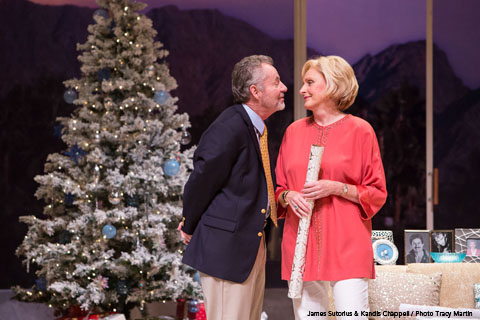
James Sutorius and Kandis Chappell. Photo by Tracy Martin.

Even a casual attendee of the theatre can tell that the sitting-room drama is currently experiencing a massive wave of popularity. It’s difficult to find a theatre these days that doesn’t have at least one show running about a group of horrible people yelling at each other in the same room. Some, like Yasmina Reza’s God of Carnage, are the most-produced plays in the world right now. Jon Robin Baitz’s Other Desert Cities, which just finished its Theatreworks run in Mountain View, is an example of the best the niche has to offer.

The play concerns the Wyeth family, a well-to-do family living in Southern California. Polly and Lyman Wyeth, the father and mother, are snooty Republicans; Polly is the ever-present psychologically abusive, alcoholic mother and Lyman acts as the more permissive parent.  Trip Wyeth, their son, is a flippant, vapid reality show producer, and Brooke, their daughter and the closest equivalent the play has to a main character, is an author who recently recovered from a deep spell of depression. Rounding out the cast is Selda, Polly’s sister, former partner, and current recovering alcoholic trapped in the house next door. When Brooke reveals that she is about to publish a memoir about her brother, who firebombed an army recruiting station and then committed suicide, the tensions underlying the family’s interactions come to a head.

Other Desert Cities takes the best of the sitting-room drama–the building tension, the subtly changing external and internal statuses of the characters–and avoids the larger problems with dialogue-heavy plays by keeping a fast pace and revealing more information with every conversation. There are issues with exposition being a little ham-handed and broader political issues appearing awkwardly in what should be a tightly focused, character-driven play, but the play as a whole is enjoyable enough that these are not particularly noticeable.

In this production, the Wyeths often turned to the audience to deliver important lines, acting as if they are constantly in front of the camera. This direction is divisive and largely depends on your taste (I don’t like it much personally), but there is no denying that it fits a family used to outside surveillance. The acting was strong across the board, with nobody standing out as better than the others particularly.

Unfortunately, the Theatreworks run is now over. However, the play itself is strong enough that if it opens again in the Bay Area or within a reachable distance, I would recommend buying a ticket.