Showing posts with label Drama. Show all posts

Saturday, June 17, 2017

Oregon Shakespeare Festival 2017: Hannah and the Dread Gazebo

Left to right: Cindy Im, Amy Kim Waschke, Sean Jones, Paul Juhn. Photo courtesy Oregon Shakespeare Festival.


The idea of theatre being an accurate representation of reality, unconsciously assumed by playwrights for thousands of years, has been called into question by the newest generation of playwrights. Jiehae Park’s latest work dispenses with these assumptions in order to better deliver its complicated message. Hannah And The Dread Gazebo, which sees its world premiere at OSF this year, twists time, space, memory, and reality to capture the meeting point of heritage, mythology, and identity in the Korean-American experience.

Though the action of Hannah is vaguely linear, it meanders into different places to provide a more complete picture of the characters’ journey. We might take a visit into a lonely subway line to learn the Korean creation myth secondhand, or journey into a dreamland, where resides the ghost of Kim Jong Il. Several long stretches of the play are in Korean, with no supertitles: These dialogue segments are used either to illustrate the difficulties of the English-speaking characters, or as comedy, punctuated with goofy uses of body language.

The plot primarily concerns three generations of a Korean family: the titular Hannah (Cindy Im), a fully Americanized medical student struggling to make sense of her identity; her mother (Amy Kim Waschke), confined and tormented, wanting more in her life but able to mask it with a wry sense of humor; and Hannah’s grandmother (Jessica Ko, who plays a number of other minor roles), who ignites the action of the play by throwing herself off a building and into the Korean demilitarized zone.

Im approaches her role with a kind of beleaguered helplessness: She knows actions aren’t going to alter the Korean political climate enough for her to retrieve her grandmother’s body, nor are they going to lower the language barrier between her and the rest of the country (Hannah barely speaks Korean) or solve her relationship problems. Despite this, though, she refuses to go down without a fight, and combats her absurd situation with kindness and whip-smart sarcasm in turn. Meanwhile, Waschke adapts to her increasingly strange surroundings while still maintaining a sense of bewilderment; despite all the bizarre things that happen, she keeps her emotional development grounded and realistic.

Hannah’s brother Dang (Sean Jones) finds himself on his own journey in a subplot that both confronts him with the mythological origin story of Dangun, the founder of Korea, and allows him to come to terms with developing his own identity in a country where everyone looks like him. While Dang is mainly the comic relief character, juxtaposing important facts about the family with a barrage of swearing, Jones injects a sense of frustration into the role that makes him a more sympathetic character. Dang, of all the characters, has the least idea about what’s going on, but we as the audience aren’t mocking him for it; rather, we understand the unfortunate circumstances that surround him.

The remaining characters in the play serve more to support the development of those more central to the plot, but produce equally excellent performances. Paul Juhn plays Hannah’s father: As the only functional Korean-speaker for the majority of the play, much of the work in finding the grandmother’s body falls to him, and he plays the tragicomic subplot of navigating government bureaucracy with a mixture of outrage and hope. Eunice Hong is a nameless girl who meets with Dang on the street: The role mostly serves to provide information about the DMZ and jokes about overenthusiastic activism, but Hong’s high-energy performance makes her a delight to watch. Jessica Ko’s multiple roles are also great, but because many of them are spoilers, it falls on you to witness her navigate them.

The set, designed by Collette Pollard, matches the mix of tradition and bureaucracy that pervades the play. A gorgeous forest sits behind a gray, square set that – thanks to David Weiner’s lighting work – even lights up at right angles. This conjures images of magic trapped within the confines of society, while also abstractly illustrating the Korean DMZ, a wildlife oasis due to the ongoing cold war between the two countries. The square lighting helps cut the otherwise bare stage into smaller parcels, useful when denoting locations like the subway or Hannah’s mother’s tiny apartment.


Hannah and the Dread Gazebo is a play unconcerned with being “proper”; rather, it departs from the known to better transmit its message of identity, mourning, and ambiguity as part of the Korean-American experience. Its strong cast, playful dialogue, and innovative use of language barriers make it a solid, eclectic work.

Hannah and the Dread Gazebo runs through October 28th.

Monday, June 12, 2017

Oregon Shakespeare Festival 2017: UniSon

Left to right: Asia Mark, Steven Sapp, Yvette Monique Clark, Kevin Kenerly. Photo courtesy Jenny Graham and the Oregon Shakespeare Festival.


UNIVERSES (Steven Sapp, Mildred Ruiz-Sapp, and William Ruiz) burst onto the Oregon stage in 2012 with their piece Party People, a daring examination of the lives of the Black Panthers and Young Lords. Now, in 2017’s UniSon, they’re using their unique style, which blends emphatic prose, spoken word, light, sound, and movement, to examine and reinterpret the unpublished poetry of the legendary playwright August Wilson. In the midst of a festival dedicated to interpreting and reimagining the works of Shakespeare, it seems fitting that one of the greatest American playwrights gains the same honor.

UniSon has a vague plot, but there’s no conventional story progression or character development. Rather, it uses a series of fragments from Wilson’s poetry to construct a metaphorical tale about an apprentice poet who, Pandora-like, opens a chest from her deceased mentor that he told her to destroy. Within it lies the poet’s failings, pains, and regrets, organized into seven “terrors” – each one represented by a member of the acting company – that give the play structure.

My favorite terror, in an aesthetic sense, is the morbidly funny Butcher (William Ruiz), a hulking figure who killed his wife when he discovered the Poet was sleeping with her. The segment is intense, with Ruiz hoarsely shouting his anger at the world and at his wife as the stage glows bright red and a butchered pig dangles from the ceiling, but its comedic elements make it reminiscent of Sweeney Todd or perhaps OSF’s 2013 The Unfortunates.  Thematically, the most interesting terror is Hunter (Mildred Ruiz-Sapp), who in a haunting tale examines the medium of poetry as a whole and whether a poet has the right to tell other people’s stories for them.

Consistent in every terror is the poet (Steven Sapp) and his distraught apprentice (Asia Mark). Asia Mark remains a terrified outsider, both in her actions and in her language, which is down-to-earth and plain compared to the poetry that surrounds her. Her shock and dismay at discovering, through his hidden work, that her image of the Poet as a kindly father figure was distorted, questions whether it’s right to keep some art hidden. Sapp’s Poet is at times remorseful, at times impishly immune, and at times torn by anguish – especially by the question of his father’s true identity. His development over the course of the play represents both his own acceptance of his past and the Apprentice’s growing understanding of him as a complete person.

The lighting and set design of UniSon is at times as important to the expression of Wilson’s poetry as the actors. Christopher Acebo’s angular set (making heavy use of video effects from Kaitlyn Pietras) juts into the middle of the action, its sharp angles hewing to modern design construction. The set is, in a way, symbolic of the show as a whole, a combination of 20th-century poetry with UNIVERSES’ postmodern theatre. Alex Jainchills’ lights pulse wildly across the stage, both in the standard top-down lights and through panels installed in the floor: This fully converts the space into whatever the play requires for its emotional expression.

UniSon is not a poetry slam, nor does it meander idly through a garden of August Wilson’s poetry. UNIVERSES has taken the work of one of the greatest American masters of language and, while still paying respect to its origins, synthesized it into a truly astounding piece that questions the need for “public” and “private” art, our views of our own heroes, and the skeletons in the closet of artistic expression that nobody wants to address. When you leave the venue, you’ll be asking a number of questions, both about the show and yourself.

UniSon runs until October 28th.

Monday, March 27, 2017

Shotgun Players: Nora

Clockwise from left: Erin Mei-Ling Stuart, Adam Elder, Michael J. Asberry, Jessma Evans, Kevin Kemp. Photo courtesy Pak Han.

In 1879, shocked audiences watched Nora leave her husband to pursue an education at the end of the first production of Henrik Ibsen’s A Doll’s House. Since then, the play’s feminist themes and complex relationships have elevated it into the pantheon of modern dramatic masterpieces. But it’s not Ibsen’s version of A Doll’s House that Shotgun Players has chosen to start off their season – rather, it’s the theatrical adaptation by legendary film director Ingmar Bergman (The Seventh Seal). The adapted script, along with Shotgun’s fascinating artistic decisions, cut away the chaff from the original to create a lean, tense experience.

Shotgun’s smartest move was not underestimating their audience; Nora is especially rich for theatregoers familiar with Ibsen’s original work. Although the basic story beats are the same, the production moves away from familial drama and into a character study of Nora herself, as she becomes increasingly pressured by a patriarchal society. Jessma Evans creates a nuanced view of the character: She takes lines that would normally indicate subservience and reinterprets them into strikes at the people who continually underestimate her. Evans’ acting is intentionally at odds with the other characters, a twenty-first-century woman stuck in a world with the masculine ideals of the nineteenth.

The most unusual character in the play, besides Nora, is Michael J. Asberry as Dr. Rank. In the original work, Dr. Rank is a dour, hopeless character, doomed both to a one-way infatuation with Nora and a painful terminal illness. However, Asberry’s poise and charisma lend the fatalistic doctor the bearing of a king, as he towers over the others in stage presence as well as height. Dr. Rank’s philosophy and motivations run perpendicular to the dignity-focused society of the play, but Shotgun’s production, backed by Asberry’s performance, asks if perhaps he was closer to the truth than the others suspected.

The other men of the play are not given such flattering treatment: Nora’s husband Torvald (Kevin Kemp) is a swaggering, condescending brute from his first line, and Krogstad (Adam Elder) is as much a villain as he was in the original text. These interpretations reflect director Beth Wilmurt’s commentary on both Ibsen’s work and modern toxic masculinity, and would be heavy handed in a more character-focused version of the play. However, in this production, which takes a more introspective, symbolic view of Nora’s struggles, these characterizations smoothly fit the broader tone. Erin Mei-Ling Stuart periodically drifts onstage as Mrs. Linde, Nora’s wife and closest ally. Though her life is difficult, Mrs. Linde is hardened enough to bear it, and is able to help Nora through her journey without pushing her. Stuart’s interpretation feels more like a force of nature than a person – a comforting breeze when needed, and a thundercrack when called for.

The technical work (Maya Linke as set designer, Allen Wilner as lighting designer, Matt Stines as sound designer) creates a sense of intense pressure as Nora’s marriage to Torvald becomes more and more unbearable. Dark ambient noise interrupts the usual theatre silence, never allowing the audience to relax; the bare, minimalistic set leaves no place for the eye to wander. However, the most interesting twist is the upstage wall, wallpapered with women’s faces and bearing a set of double doors that lead to Torvald’s office. The wall clearly delineates Torvald’s life from Nora’s, the man’s sphere from the woman’s, pushing slowly forward over the course of the show until only a few feet remain for the female characters to stand. It’s a brilliant work of nonverbal poetry that ties together the larger themes of the show.


Nora at Shotgun Players explores new meaning in a text familiar to theatre veterans, yet still presents a coherent story for newcomers. The themes and characters from the original are adapted to fit a modern context and the director’s vision, but not so much to be unrecognizable. While the base text is a Swedish play written over a century ago, Nora – and innovative companies like Shotgun – represent the future of American theatre.

Sunday, March 13, 2016

Theatreworks: tokyo fish story


Left to right: Francis Jue, Linden Tailor, James Seol. Photo courtesy Kevin Berne and Theatreworks.


Very few activities reflect the human spirit and its desire for transcendence like the precision and craft of cuisine. In particular, the culture built around sushi and its construction, as revealed to broader America in the documentary Jiro Dreams of Sushi, is slow, grueling, and demanding of perfection. Kimber Lee’s tokyo fish story, directed at Theatreworks by Kirsten Brandt, uses both character interactions and broader structure to contrast the art of sushi with the demands of the real world.

In a way, tokyo fish story is two plays at once: The poetic saga of sushi master Koji (Francis Jue), as his restaurant weathers a changing Japan, and the realist drama of his son Takashi (James Seol), who quashes his own culinary innovations out of fealty to his father. The merger of the two serves not only as a multifaceted look at a complex family relationship, but gives Koji the vulnerability he needs to become more than just a strict father.

Seol’s Takashi is the standout performance in the Theatreworks production. Though second apprentice Nobu (Linden Tailor) makes fun of him for being almost as uptight as Koji, in reality Takashi masks the pain of not knowing whether his father will ever see him as an equal. Takashi is a different person to every character in the play, and Seol portrays him with the beautiful emotional delicacy required for the audience to understand this.

Nobu’s role is meant to push Takashi into action and to provide a dose of levity. A lot of plays have similar “jester” characters, many of whom are loud and into pop culture (Star Wars in this case). Nobu serves this role while genuinely caring about his job and his mentor. While Tailor never tones down his intensity, he still finds ways to show his dedication to his work.

Wilson Chin’s set flips the conventions of the proscenium theatre on its head to meet the varying needs of the production. Normally, the stage is used to create a two-dimensional effect like a television screen, but here, the multi-tiered wooden framing and use of suspended sculpture create a theatre space that can be unified or split into narrow zones as the direction demands. This creates room for the actors to maneuver, but still feels cramped and uncomfortable like a tiny kitchen.


tokyo fish story at Theatreworks is a look into a life profoundly different from our own, where a three-decade apprenticeship is not unexpected, and one can not notice a neighbor has been gone for two years. It’s a play that observes multiple lives traveling at different speeds, and how someone “irrelevant” can still be incredibly important. Rather than critiquing the pace of the current generation, Lee is simply sitting at the counter and asking us questions about how things will change.

Sunday, September 15, 2013

Theatreworks: Other Desert Cities

other desert cities
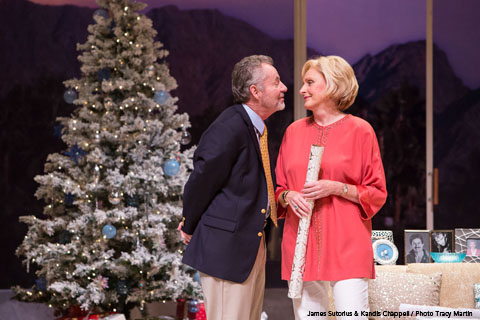
James Sutorius and Kandis Chappell. Photo by Tracy Martin.

Even a casual attendee of the theatre can tell that the sitting-room drama is currently experiencing a massive wave of popularity. It’s difficult to find a theatre these days that doesn’t have at least one show running about a group of horrible people yelling at each other in the same room. Some, like Yasmina Reza’s God of Carnage, are the most-produced plays in the world right now. Jon Robin Baitz’s Other Desert Cities, which just finished its Theatreworks run in Mountain View, is an example of the best the niche has to offer.

The play concerns the Wyeth family, a well-to-do family living in Southern California. Polly and Lyman Wyeth, the father and mother, are snooty Republicans; Polly is the ever-present psychologically abusive, alcoholic mother and Lyman acts as the more permissive parent.  Trip Wyeth, their son, is a flippant, vapid reality show producer, and Brooke, their daughter and the closest equivalent the play has to a main character, is an author who recently recovered from a deep spell of depression. Rounding out the cast is Selda, Polly’s sister, former partner, and current recovering alcoholic trapped in the house next door. When Brooke reveals that she is about to publish a memoir about her brother, who firebombed an army recruiting station and then committed suicide, the tensions underlying the family’s interactions come to a head.

Other Desert Cities takes the best of the sitting-room drama–the building tension, the subtly changing external and internal statuses of the characters–and avoids the larger problems with dialogue-heavy plays by keeping a fast pace and revealing more information with every conversation. There are issues with exposition being a little ham-handed and broader political issues appearing awkwardly in what should be a tightly focused, character-driven play, but the play as a whole is enjoyable enough that these are not particularly noticeable.

In this production, the Wyeths often turned to the audience to deliver important lines, acting as if they are constantly in front of the camera. This direction is divisive and largely depends on your taste (I don’t like it much personally), but there is no denying that it fits a family used to outside surveillance. The acting was strong across the board, with nobody standing out as better than the others particularly.

Unfortunately, the Theatreworks run is now over. However, the play itself is strong enough that if it opens again in the Bay Area or within a reachable distance, I would recommend buying a ticket.